
"Do I really need a smoke alarm in every bedroom of my rental? And if something goes wrong, what do I have to be able to prove?"
I hear that from owners in Keller, Roanoke, Northlake, Haslet, Flower Mound, Justin and Decatur all the time. Smoke alarms are cheap, but Texas has specific rules for them in rentals, and the owners who get burned are usually the ones who did the right thing but can't show it.
Here's my honest read on what Texas Property Code Chapter 92, Subchapter F (§§ 92.251-92.264) requires of DFW rental owners.
The Short Answer
Install at least one working smoke alarm in every bedroom, in the hallway that serves the bedrooms, and on every level of the home. Test every alarm at the start of each new lease, and write it down with photos. During the lease, inspect and repair when your resident asks, within a reasonable time. After move-in, replacing batteries is generally the resident's job, as long as the alarms worked when they moved in. If you have a fire extinguisher in the home, check it at move-in too.
What You Have to Install
- One in each bedroom: § 92.255(a) requires at least one smoke alarm in each separate bedroom (Texas Property Code § 92.255).
- The hallway and every level: If several bedrooms share a corridor, you need at least one alarm in that corridor near the bedrooms. A two-story home needs at least one on each level.
- The right kind of alarm: Under § 92.254, the alarm has to detect both visible and invisible products of combustion, be loud enough to hear in the bedrooms it serves, and be listed by Underwriters Laboratories (UL), Factory Mutual or United States Testing Company. On request as a hearing-impairment accommodation, it must also be able to alert a hearing-impaired person.
- Battery or hardwired: For homes first occupied, or given a certificate of occupancy, before September 1, 2011, § 92.255(b) allows battery-powered alarms that aren't interconnected. The catch: a replacement for an original alarm has to meet the building code standards that applied when the home was first occupied. In plain English, if your older Keller or Decatur house came with hardwired alarms, replace them with hardwired alarms. Newer homes in Northlake and Haslet were generally built under codes calling for hardwired alarms, so keep them that way.
- Proper placement: Under § 92.257, follow the manufacturer's instructions. A ceiling alarm goes no closer than six inches to a wall; a wall alarm goes six to 12 inches from the ceiling.
Cities can add requirements through their fire, building and housing codes (§ 92.252), so check your city's rules too.
Testing: When It's Your Job and When It Isn't
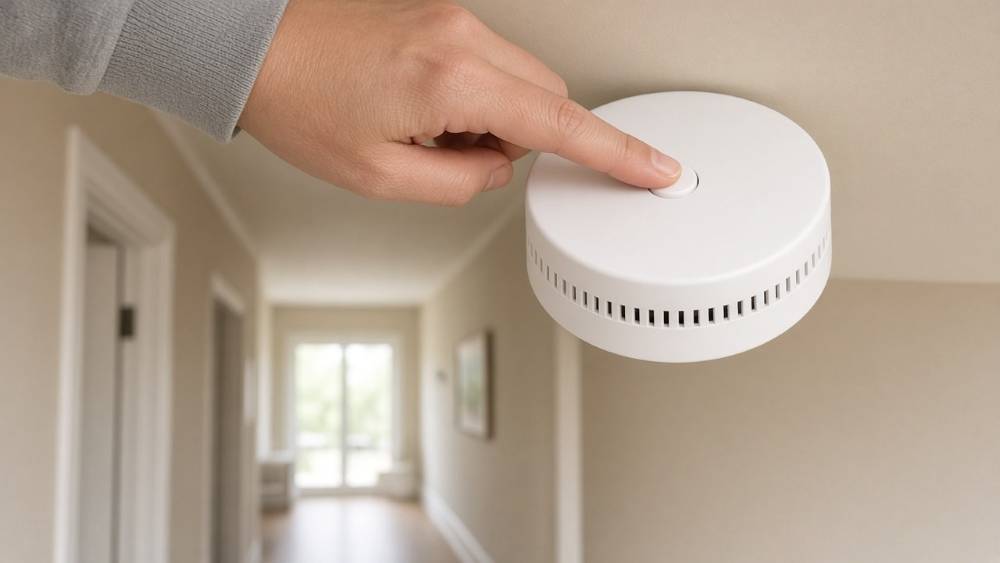
- At the start of every lease: § 92.258(b) requires the landlord to confirm each alarm is in good working order at the beginning of the tenant's possession, by testing with smoke, the test button or the manufacturer's procedure.
- During the lease: Under § 92.258(c), your duty to inspect and repair kicks in when the resident reports a malfunction or asks for an inspection. You have to respond within a reasonable time (§ 92.258(d)).
- Batteries after move-in: If the alarm worked when the resident took possession, you're not obligated to provide batteries after that (§ 92.258(f)). An alarm that worked at move-in is presumed to keep working until the resident asks for a repair (§ 92.258(g)).
- Resident-caused damage: If the resident or their guests damage the alarm, you don't have to fix it at your cost. You only have to repair or replace it if the resident pays the reasonable cost in advance (§ 92.258(c)).
Why Documentation Is the Whole Game
The move-in presumption only helps if you can show the alarms worked on day one. Document it: a line for every alarm on the move-in condition report that the resident signs, plus dated photos or a short video of each test.
The stakes are real. If you didn't install required alarms at initial occupancy, or you don't fix one within seven days after the resident's written notice, § 92.259 makes you liable, and § 92.260 lists remedies including a civil penalty of one month's rent plus $100, attorney's fees and termination of the lease. That's the risk a good process avoids.
Texas also gives owners tools. Under § 92.259(b), a written lease can require the resident's first request for alarm repair to be in writing. And § 92.2611 lets you recover damages from a resident who pulls a battery without replacing it or knowingly disables an alarm, with added penalty remedies if your lease has an underlined or bold notice about it and the resident ignores a separate seven-day written notice.
According to the National Fire Protection Association, nearly three out of five U.S. home fire deaths from 2018 to 2022 happened in homes with no smoke alarms (43 percent) or alarms that failed to operate (16 percent).
Don't Forget the Fire Extinguisher
If you've installed a fire extinguisher, §§ 92.263-92.264 apply. Check it at the start of each lease and after a written request: confirm it's there and the gauge shows the correct pressure. If it isn't working or the resident used it for a legitimate reason, repair or replace it at your expense.
The Property Management Angle
Here's how this works at Salsberry. We test every alarm at the start of each lease and record it in the move-in documentation. Residents report problems through the portal or our 24/7 line, and we handle alarm issues promptly, so a seven-day clock never becomes your problem. Under § 92.262, the managing agent is the landlord's agent for notices under this subchapter, which means those notices come to us and we act on them.
Between Parker and me, we bring 22+ years of combined experience, we've leased more than 500 homes with about 12 average days on market, and we've earned 70+ five-star reviews. We manage residential homes only. Our pricing is simple: an 8% monthly management fee and a leasing fee of 50% of the first month's rent, or Placement Only for 100% of one month's rent, and there are no other fees. Our contracts are month-to-month, so you can cancel anytime, and if we place the tenant, we handle an eviction for free. See our pricing page, and you can see how we handle repairs on our maintenance services page.
This post is general information, not legal advice. Statutes change, and your city may have additional requirements. Talk to a Texas attorney about your specific situation.
Want a Second Set of Eyes on Your Rental?
If you own a rental in Keller, Roanoke, Northlake, Justin or nearby, I'm happy to do a free, no-obligation review and tell you honestly where you stand, from smoke alarms to rent pricing. Call (304) 878-8629 anytime, or reach out through our contact page. You can also read about our Keller property management, Roanoke property management, Northlake property management and Justin property management.